
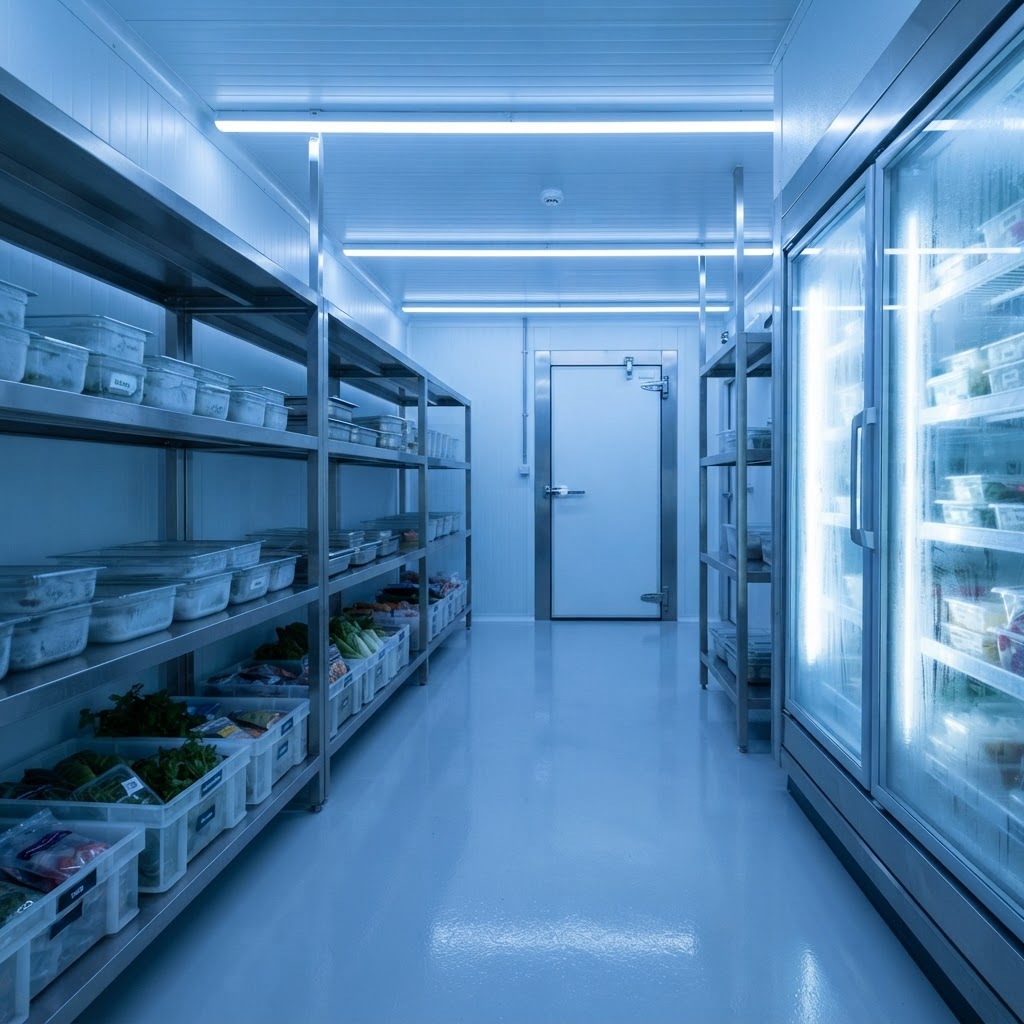
The problem: the cold room nobody wants to clean
A commercial coolroom is the backbone of a food business — it's where the stock is held, the temperature is critical, and the food-safety standards are non-negotiable. And it's also the room that's hardest to clean, most unpleasant to work in, and most often deferred.
The problem is that a coolroom is a sealed, cold, humid environment — and that's exactly the environment where mould, biofilm, bacteria and food residue thrive. The cold slows the growth but doesn't stop it. The humidity condenses on every surface. The food residue — from spills, from packaging, from the daily traffic of stock in and out — builds up on the shelving, the floor, the door seals and the hard-to-reach corners. And the condenser and evaporator fans, which pull air through the unit, collect a dust-and-grease film that reduces cooling efficiency and spreads contamination.
For Newcastle food businesses — restaurants, cafes, butchers, delis, supermarkets, food manufacturers — a dirty coolroom is a food-safety risk, a health-inspection failure, and a cooling-efficiency cost. It's not a cosmetic issue; it's a compliance and operational issue that affects the bottom line.
Understanding the contamination
A coolroom has several distinct contamination zones, and each needs a different approach:
Shelving and interior surfaces. Food residue, mould and biofilm build on the shelving and the walls. The biofilm — a thin, invisible layer of bacteria that adheres to surfaces — is the food-safety risk; it's not visible but it's there, and it needs a proper sanitiser, not just a wipe, to remove. Mould appears in the corners, on the door seals, and on any surface that stays damp.
Door seals and gaskets. The rubber seals around the door are the single most mould-prone surface in a coolroom. The seal is damp, it's in a cold-dark junction, and it collects food residue from the daily traffic. A mouldy seal isn't just unsightly — it's a contamination source and it affects the door's seal, which lets cold air escape and warm air in, raising the temperature and the energy cost.
Condenser and evaporator fans. The fans that circulate the air in the coolroom collect a dust-and-grease film on the blades and the housing. A dirty fan is less efficient (it costs more to run) and it blows contamination back into the coolroom every time it runs. The evaporator coil, which is where the cooling happens, can also ice up if the airflow is restricted by dust — and an iced coil stops cooling entirely.
Cold display cabinets. The front-of-house display units — the chilled cabinets in a deli, the cold shelves in a supermarket, the display fridge in a cafe — have the same contamination zones as a walk-in coolroom, plus the added challenge of being customer-facing. A dirty display cabinet is a direct food-safety risk and a customer-confidence issue.
Floors and drains. The floor of a coolroom is cold, damp, and collects the spills and the traffic. The drain (if the coolroom has one) can clog with food residue and become a contamination source. A floor that's not properly cleaned is a slip hazard and a food-safety hazard.
The solution: a food-safety-grade clean
A proper coolroom clean is a food-safety-grade clean, not a cosmetic wipe. It's methodical, it uses food-safe products, and it addresses every zone. Here's the process:
-
Stock removal or protection. The stock is either removed from the coolroom (the ideal — a full empty clean) or protected and moved to one side (for a partial clean). A full empty clean, done on a down day or after hours, is the proper approach — it allows every surface to be cleaned without contamination risk.
-
Shelving and surfaces. The shelving is emptied, washed with a food-safe degreaser and sanitiser, and dried. The walls are wiped with the same food-safe approach. The biofilm is addressed with a proper sanitiser, not just a detergent — the difference is that a sanitiser kills the bacteria; a detergent just moves it.
-
Door seals and gaskets. The seals are the detail zone that matters most for food safety. They're cleaned with a mould-killing product, the mould is removed from the grooves, and the seals are dried. A seal that's mouldy through the join may need replacing — and we'll tell you if that's the case.
-
Condenser and evaporator fans. The fan blades and housings are vacuumed and wiped. The evaporator coil is carefully cleaned (this is a delicate job — the fins bend easily) with a coil cleaner that dissolves the grease-and-dust film. The difference in cooling efficiency after a coil clean is often dramatic — the unit runs less, cools better, and costs less in power.
-
Cold display cabinets. The same food-safe approach, with the added attention to the customer-facing glass and the presentation surfaces. A display cabinet that's clean inside and out is a food-safety asset and a customer-confidence asset.
-
Floors and drains. The floor is cleaned with a food-safe floor cleaner, and the drain is cleared and sanitised. A clogged drain is a contamination source and a flood risk; a clear drain is a food-safety essential.
-
Final sanitisе and dry. The entire unit is given a final sanitising pass and dried — because a dry coolroom is a coolroom that resists mould regrowth. The unit is then returned to temperature and the stock is replaced.
How Hearts Cleaning can help
Our coolroom and cooling fan cleaning service is built for Newcastle food businesses that take food safety seriously. Here's what we bring:
- Coolroom interiors, shelving and seals. A food-safe, methodical clean of every interior surface — the shelving, the walls, the door seals, the corners. The biofilm and the mould are addressed with proper products, not just a wipe.
- Condenser and evaporator fan cleaning. The fans and coils that affect cooling efficiency and air quality. A clean fan runs better, costs less, and doesn't blow contamination back into the coolroom.
- Cold display cabinet cleaning. The front-of-house units that are customer-facing and food-safety-critical. Clean inside and out.
- Mould and biofilm removal. The specific contaminants that thrive in a cold, humid environment. Professional-grade, food-safe products that kill the mould and the biofilm, not just remove the visible signs.
- Food-safety hygiene standards. We work to food-safety standards, we use food-safe products, and we follow the hygiene protocols that a food business needs for compliance.
- Flexible scheduling around your hours. We work after hours, on down days, or at whatever time suits your business — because a coolroom clean shouldn't disrupt your operation.
- Custom quote based on your units. Because every coolroom and business is different, we provide a custom quote based on the size, the number of units, and the level of build-up.
You can request a coolroom cleaning quote through the Quote Wizard (tell us about your business and your units), or contact us directly to discuss a recurring schedule.
The smart move for most Newcastle food businesses is a scheduled coolroom clean — monthly for high-use units, quarterly for moderate use — that keeps the mould, the biofilm and the fan dust from ever becoming a food-safety issue. A scheduled clean is cheaper than a compliance failure, and it's a lot cheaper than a coolroom that's running inefficiently because the coils are clogged.
Quick answers
How often should a commercial coolroom be cleaned? Monthly for high-use units (restaurants, busy delis), quarterly for moderate use. A scheduled clean keeps the mould, biofilm and fan dust from becoming a food-safety issue.
Do you use food-safe products? Yes. We use food-safe, food-safety-grade products that are effective against mould, biofilm and bacteria, and that are safe for use in a food storage environment. We follow food-safety hygiene standards.
Can you clean the condenser and evaporator fans? Yes — and this is one of the most impactful parts of a coolroom clean. A clean fan and coil run more efficiently, cost less in power, and don't blow contamination back into the coolroom.
How do you price coolroom cleaning? We provide a custom quote based on the size and number of units, the level of build-up, and the scope of work. Because every coolroom and business is different, no fixed price — but a clear quote before we start.
Can you work after hours? Yes. We work around your operating hours — after hours, on down days, or at whatever time suits your business. A coolroom clean shouldn't disrupt your operation.