Why the kitchen is the hardest-working room in your home
The kitchen is the one room in the house that gets dirty every single day. Every meal leaves a trace — a splatter on the splashback, a smear on the handle, a crumb in the corner, a film on the floor. Multiply that by three meals, plus snacks, plus the inevitable kettle boil and you have a room that accumulates grime faster than every other room combined.
For Newcastle families, the kitchen is also the heart of the home. It's where the day starts, where homework happens, where guests gather. A kitchen that feels genuinely clean lifts the whole house. A kitchen that feels grimy drags the whole house down with it.
This guide walks through every surface in a domestic kitchen — what to clean, how to clean it, how often to clean it, and the detail zones that separate a quick wipe from a proper clean. Whether you do it yourself or bring in help, knowing the system means you can benchmark the standard you're aiming for.
The daily reset: 10 minutes that save your weekend
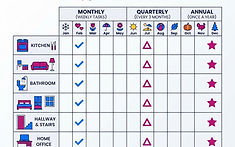
The single most effective habit in kitchen cleaning is the daily reset. Ten focused minutes every evening keeps the kitchen from ever needing a heroic weekend recovery. The daily reset covers:
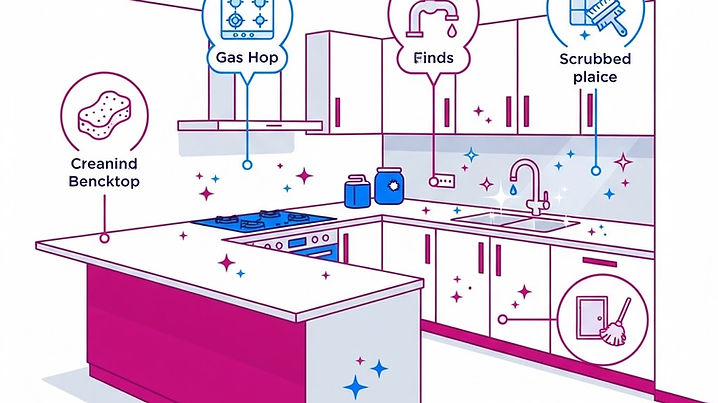
- Clear and wipe all benchtops. Crumbs first (a bench scraper or microfibre cloth), then a damp wipe with a mild spray. Work from the cleanest area (the far bench) toward the sink so you're not dragging dirt across clean surfaces.
- Wipe the stovetop. While it's cool, wipe any splatter from the day's cooking. Dried-on splatter becomes baked-on splatter tomorrow.
- Sink and tapware. Empty the sink, give it a quick scrub, then polish the tap with a dry microfibre cloth. A dry tap doesn't water-mark, and water marks are what make a sink look tired.
- Floors — a quick sweep only. A two-minute sweep of the high-traffic zone (in front of the sink and stove) keeps crumbs from being ground in. The full mop can wait for the weekly clean.
- Reset the dishwasher. Empty it if it's finished, or start it if it's full. A running or empty dishwasher keeps the bench clear.
That's it. Ten minutes, every evening. The compounding effect is enormous — a kitchen that's been daily-reset for a month never reaches the state where a deep clean becomes a project.
Weekly clean: the surfaces that need a proper pass
Once a week, the kitchen needs more than a reset. The weekly clean lifts the grime that a daily wipe leaves behind and resets the high-touch zones. A sensible weekly order:
Start high, finish low. Dust settles downward, so always work from the top of the room down. Ceiling cobwebs and the top of the fridge first, then upper cabinets and splashback, then benchtops and appliances, then lower cabinets, then floor last.
Splashback and wall tiles. A 1:1 vinegar-water spray (or a dedicated tile cleaner for natural stone) lifts cooking grease. Work in sections, agitate with a microfibre cloth, and rinse with a clean damp cloth. Dry off with a second cloth for a streak-free finish.
Stovetop and control panel. Remove knobs if possible and soak them. Clean the stovetop thoroughly — gas burners should have their trivets removed and washed in the sink; induction or ceramic glass needs a dedicated cooktop cleaner to avoid scratching. Dry everything before reassembly.
Sink and drain. Sprinkle bicarb soda over the sink, pour white vinegar over it, and let the fizzing action work for five minutes. Scrub with a non-scratch sponge, rinse, and finish with the dry-cloth polish on the tap. For a smelly drain, pour half a cup of bicarb followed by half a cup of vinegar, then flush with boiling water after 10 minutes.
Small appliances. Microwave interior (heat a bowl of water with lemon slices for five minutes, then wipe — the steam does the work), toaster crumb tray, kettle descale (half white vinegar, half water, boil, rinse thoroughly), coffee machine per manufacturer instructions.
Floors — the full sweep and mop. Sweep or vacuum first to remove loose grit that would smear during mopping. Use a pH-neutral floor cleaner appropriate to your surface (timber, tile, vinyl and polished concrete all need different products). Mop in sections and rinse the mop head frequently — a dirty mop just redistributes grime.
The fridge exterior and handles. High-touch surfaces pick up finger marks and food residue fast. A damp microfibre wipe with a mild spray, finished dry, keeps the fridge looking new.
Monthly: the zones that quietly accumulate
Once a month, the kitchen needs attention in the zones that quietly accumulate grime between weekly cleans. These are the zones that, if neglected, become the source of odours, pests and the slow visual decline that makes a kitchen feel old before its time.
Inside the fridge. Empty it shelf by shelf. Toss anything past its date. Wash shelves and drawers in warm soapy water — don't put plastic drawers back in wet, they'll warp. Wipe the interior with a bicarb solution (one tablespoon per litre of water) to neutralise odours. Check the door seals; a damp seal grows mould. Dry everything before reassembly.
Pantry audit. Wipe shelves, check expiry dates, and consolidate open packets. A pantry with half-open bags of flour and out-of-date cans is a pantry that attracts pests. Rotate stock so older items are at the front.
Rangehood and splashback behind the stove. The rangehood filter collects cooking grease that, if left, becomes a sticky residue that attracts dust and eventually drips. Remove the filter and soak it in hot water with dish soap and a splash of ammonia-free degreaser. For stainless rangehoods, work in the direction of the grain with a stainless cleaner.
Under and behind small appliances. The toaster, kettle and coffee machine on the bench all have a shadow zone beneath them. Lift each one, wipe under it, and check for the crumbs and sticky spots that build up out of sight.
Kickboards and the toe-kick under cabinets. The recessed kickboard under your cabinets is a magnet for dust, pet hair and dropped crumbs. A vacuum with a crevice tool, then a damp wipe, keeps it from becoming a haven for pests.
Quarterly: the detail zones that define a deep clean
Every three months — or at the change of each season — the kitchen benefits from a detail pass that goes well beyond the weekly clean. This is the scope of a professional deep clean, and it's the work that keeps a kitchen looking new for years rather than tired after two.
Inside all cabinets and drawers. Empty each one, wipe the interior (a mild spray and a microfibre cloth), and replace shelf liner if it's looking tired. Check hinges for dust — the top of a hinge is a quiet collector. This is also the moment to declutter; cabinets accumulate expired spices, duplicate utensils and gadgets that never get used.
Behind and under the full-size appliances. Pull the fridge and the stove out from the wall (carefully — on a vinyl or timber floor, put a protective sheet down first). The floor beneath will be grimy. The wall behind will have a grease film. The coils on the back of the fridge will be dusty — and dusty coils make the fridge work harder and cost more to run. Vacuum the coils gently, wipe the wall and floor, then push the appliances back.
The oven. A quarterly oven clean keeps baked-on carbon from becoming permanent. Either run a commercial oven cleaner (follow the instructions, ventilate, and protect the floor beneath the door) or use the bicarb-vinegar method: coat the interior in a thick bicarb paste, leave overnight, then scrub and rinse. The oven door glass responds to a bicarb paste and a non-scratch sponge. For a professional single-oven clean, expect to pay from $165 (including up to two trays); a double oven from $240.
Tile and grout in the splashback. Grout is porous and, over months, absorbs cooking grease and discolours. A dedicated grout cleaner, a stiff-bristled brush (not metal — it scratches the grout), and a thorough rinse will lift most discolouration. For stubborn areas, a bicarb paste left for 15 minutes before scrubbing helps.
Light fittings and ceiling fans. The kitchen ceiling fan and pendant lights collect a greasy dust that a dry duster just smears. A damp microfibre cloth with a little dish soap, followed by a dry wipe, removes it properly. Turn the power off first.
The zones everyone forgets
Even a diligent weekly clean misses a handful of zones. Knowing them is the difference between a kitchen that's clean and a kitchen that's genuinely clean:
- The top of the fridge and upper cabinets. Out of sight, out of mind — and a visible dust line from across the room.
- The hinge side of the oven door. The side that faces the splashback and collects grease nobody sees when the door is closed.
- Inside the cutlery drawer. The drawer itself, not the insert. Lift the insert and the floor of the drawer will surprise you.
- The seal around the dishwasher door. A damp rubber seal grows black mould fast. Wipe it with a bicarb solution and dry it.
- The base of the tap where it meets the sink. A classic spot for limescale and green discolouration.
- The switchplates and power points. Greasy finger marks collect around every switch in a kitchen.
- The bin and the bin cabinet. The bin itself should be wiped inside and out weekly; the cabinet it sits in should be cleaned monthly.
Products that work — and the ones to avoid
A few well-chosen products outperform a cupboard full of specialty sprays. For most Newcastle kitchens, a basic kit covers everything:
- Microfibre cloths (a stack of them). The single most important tool. Use one damp, one dry, and change them frequently.
- A pH-neutral benchtop cleaner for daily use.
- White vinegar for glass, tile, stainless and descaling.
- Bicarb soda for scrubbing, deodorising and paste-based stain removal.
- A dedicated oven cleaner (used sparingly, with ventilation).
- A ceramic cooktop cleaner if you have induction or glass.
- A non-scratch scourer for stubborn food without scratching.
Avoid: bleach on food surfaces (it's overkill and taints), ammonia on natural stone, and any abrasive powder on glass or stainless steel. The "more is better" instinct with cleaning products is wrong — a well-chosen product used correctly beats a strong product used carelessly.
How Hearts Cleaning can help
If reading this guide makes you realise your kitchen has slipped past what a weekly reset can recover, that's exactly what our deep cleaning is built for. Our kitchen deep clean is $88 per cleaner per hour including chemicals, with a four-hour minimum (from $352), and it targets every zone covered in this guide — the detail zones, the behind-and-under areas, the inside-cabinet pass, the oven, the splashback and the grout.
For ongoing maintenance, our general cleaning at $60 per cleaner per hour including chemicals (four-hour minimum, from $240) keeps your kitchen at the standard the daily reset is designed to protect. We bring professional-grade products and equipment, and we offer child-safe and pet-safe options for households that want them.
The smart move for most busy Newcastle families is a regular general clean with a quarterly deep clean — the ongoing comfort of maintenance plus the periodic reset that keeps the detail zones from ever getting truly bad. You can request an estimate in 30 seconds with our Quick Estimate, or use the Quote Wizard to tell us about your kitchen and book a date.
A clean kitchen isn't a luxury. It's the foundation of a home that feels under control. Whether you do it yourself or bring us in, the system is the same — daily reset, weekly pass, monthly zones, quarterly detail — and the result is a kitchen that works as hard as you do.