
The outdoor zones that face the coast
For Newcastle homes, the outdoor spaces — balconies, patios, decks, pavers, windows and the building exterior itself — face a challenge that inland homes don't: salt spray, humidity, and the mould that thrives in a coastal climate. A beachside home needs more frequent outdoor cleaning than one a few suburbs inland, even when both look "fine" to a quick glance.
This guide walks through every common outdoor surface, with the right method, the right frequency, and the products and techniques that protect rather than damage. The good news is that outdoor cleaning, done on a system, is mostly about frequency rather than effort — a regular light pass is far more effective than an occasional heroic one.
The coastal climate's three challenges
Before the surface-specific advice, it helps to understand what Newcastle's outdoor surfaces are actually facing:
Salt spray. Carried on the wind from the ocean, salt deposits on every surface — glass, metal, timber, pavers, the building facade. Left in place, salt is corrosive (it pits metal fittings, tarnishes chrome, and accelerates the wear of painted surfaces) and etches glass over time. The fix is regular fresh-water rinsing; the salt dissolves and runs off before it can do damage.
Mould and algae. Newcastle's humidity is ideal for the green and black growth that appears on pavers, decks, shaded timber, and the south-facing walls of buildings. Mould needs moisture, shade and a surface to grip. The fix is to break the triangle — clean to remove the growth, improve drainage to reduce moisture, and trim vegetation to let light and air in.
UV and heat. The Australian sun is harsh on every outdoor surface. Timber decks grey without oil, painted surfaces chalk without washing, and pavers fade without sealing. The fix is regular re-oiling, re-painting and re-sealing — the protective layers that stand between the surface and the sun.
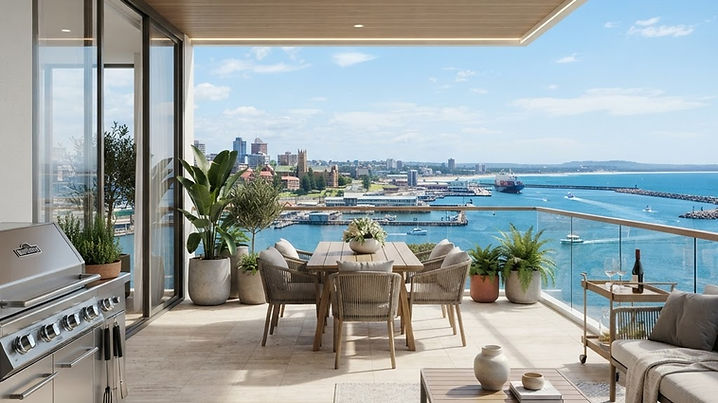
Balconies and patios
Balconies and patios are the outdoor rooms — and they're the zones that get dirty fastest, because they're exposed to all three coastal challenges plus the everyday foot traffic.
Daily: a quick sweep. Two minutes with a broom removes the leaves, sand and grit that would otherwise be ground in. This is the single highest-return outdoor habit.
Weekly: a wipe of furniture and a rinse of the floor. Outdoor furniture gets a damp microfibre wipe (salt and dust settle on every surface). A rinse of the floor with a hose (or, for a small balcony, a mop bucket of fresh water) flushes the salt. Don't forget the railing — a salt-covered railing transfers to hands and clothing.
Monthly: a full wash. A pressure wash on a low-to-medium setting lifts the grime that sweeping and rinsing can't. For a small balcony, a stiff broom and a bucket of water with a mild outdoor cleaner does the job. Pay attention to the corners and the junction between the floor and the wall — the zones where mould takes hold.
Quarterly: a mould pass. If your balcony is shaded, a dedicated outdoor mould remover (or a 1:1 vinegar-water solution) applied, left for 15 minutes, then rinsed, keeps the green growth at bay. This is especially important on the south-facing walls and in the corners that never see direct sun.
Annually: a detail pass. The railing gets a full clean and a polish, any timber gets a re-oil, and any metal fittings get a corrosion check. A small spot of rust caught early is a 10-minute fix; the same rust left for a year is a full railing replacement.
Pavers and outdoor tiles
Pavers are the outdoor floor — and they're the surface most affected by mould in a coastal climate. Green and black growth on pavers is unsightly, slippery when wet, and a sign that the surface is holding moisture.
Weekly: a sweep. As with any floor, removing loose debris first prevents it being ground in.
Monthly: a pressure wash. A low-to-medium pressure setting lifts the growth without damaging the surface. For stubborn areas, apply a dedicated outdoor mould remover or a vinegar-water solution, leave for 15 minutes, then pressure wash. Work in sections and rinse thoroughly.
Quarterly: a deep clean and re-sand. If your pavers are jointed with sand (as many are), the pressure washing will remove some of the jointing sand. A re-sand with kiln-dried sand keeps the pavers stable. For pointing-jointed pavers, a check for any cracked pointing and a repair is the quarterly job.
Annually: re-seal. A paver sealer repels water, oil and mould, and keeps the colour true. A professionally sealed paver surface stays clean for far longer than an unsealed one. The re-seal is annual for high-traffic areas, every two years for low-traffic.
Avoid: high-pressure settings on soft stone pavers (limestone, sandstone) — it pits the surface; acidic cleaners on natural stone; and metal-bristled brushes, which scratch and leave rust flecks.
Timber decks
Timber decks are beautiful and high-maintenance. In a coastal climate, an un-oiled deck greys within months and starts to splinter within years. The right care keeps a deck looking good for decades; the wrong care ages it rapidly.
Weekly: a sweep. Removes the leaves that would otherwise compost into the timber and stain it.
Monthly: a rinse and a check. A fresh-water rinse flushes the salt and the dust. A check for any loose boards, raised nails, or early signs of rot — caught early, these are small fixes; left, they become a full deck replacement.
Quarterly: a clean. A dedicated deck cleaner (not a generic outdoor cleaner, which can strip the oil) and a soft brush, rinsed thoroughly. Avoid pressure washing on a high setting — it lifts the timber fibres and splinters the surface. A low-pressure setting, held at least 30cm from the surface, is acceptable if you're careful.
Annually: a re-oil. This is the single most important deck care habit. A quality decking oil, applied annually (or every two years for a sheltered deck), keeps the timber hydrated, repels water, and protects against UV. The deck should be cleaned and fully dry before oiling — the oil needs to soak into bare timber, not sit on a film of grime.
Avoid: pressure washing on high, generic outdoor cleaners (they strip the oil), and leaving the deck wet for extended periods (which encourages mould and rot).
External windows
External window cleaning is one of the most-transforming cleans you can do — the difference in light and outlook is out of all proportion to the time it takes. In a coastal climate, the salt build-up on external glass is the main reason windows look dull even when the inside is clean.
Weekly: a rinse. A hose with a spray nozzle, run over the external glass, dissolves and flushes the salt before it can etch. This is the single most effective anti-salt habit for a beachside home.
Quarterly: a full clean. A dedicated glass cleaner, a squeegee, and a microfibre cloth for the edges. The squeegee is the key tool — a squeegeed window dries streak-free; a wiped window often doesn't. Work from the top down, overlap each squeegee stroke, and finish the edges with the cloth.
Annually: a full frame and track detail. The window frames (aluminium, timber or uPVC) need a clean and a check for any corrosion or rot. The tracks need a vacuum with a crevice tool and a wipe. The weep holes (the small drainage slots at the bottom of the frame) need to be clear — a blocked weep hole lets water pool in the track and overflow inside.
Avoid: abrasive scourers on glass, high-pressure washing on the frames (it can force water behind the seals), and cleaning external glass in direct sunlight (the cleaner dries before you can squeegee it off, leaving streaks).
The building exterior and facade
The facade of a home or commercial building is the surface that takes the most weather and gets the least attention. A dirty facade ages a building's appearance dramatically; a clean facade transforms it.
Quarterly: a rinse. For a single-storey home, a hose with a spray nozzle run over the facade flushes the salt and dust. For a two-storey home, this is harder and often a professional job.
Annually: a full wash. A low-pressure wash (or a soft-brush wash for delicate surfaces) with a dedicated exterior cleaner. High-pressure washing on a facade can force water behind the cladding and into the wall cavity — for most homes, a low-pressure wash is more than adequate and far safer. For a two-storey or commercial facade, this is a professional job.
Annually: a check for mould and corrosion. The south-facing wall, the shaded side, and the area under the eaves are the zones where mould takes hold. A dedicated mould remover, applied and rinsed, keeps it in check. Any rusting metal fittings (railings, downpipes, brackets) should be treated and repainted before the rust spreads.
Gutters and downpipes
Gutters are the outdoor system that protects the whole building. A blocked gutter overflows, runs down the wall, and causes damage that costs thousands to fix. A clear gutter protects the roof, the walls, the foundations and the interior.
Quarterly: a clear. Especially in autumn (leaf fall) and after storms. A gloved hand or a gutter scoop removes the leaves and the silt that builds up. A hose run through the downpipe checks that it's clear — if it backs up, the downpipe is blocked and needs to be cleared with a plumber's snake or a high-pressure hose.
Annually: a full inspection. A check for any sagging, any rust, any loose brackets, and any failed joins. A small repair caught early is cheap; the same repair after a storm has caused water damage is expensive.
Safety: gutter cleaning on a two-storey home is a job for a professional — the risk of a fall is real, and the cost of a professional clear is far less than the cost of an injury.
How Hearts Cleaning can help
For the outdoor cleaning that's beyond a weekly sweep — external window cleaning, paver pressure washing, a building facade wash, a deck re-oil prep — we can help. Our window cleaning is $60 per cleaner per hour including chemicals, with a four-hour minimum (from $240); our general cleaning covers the routine outdoor pass; and our building cleans cover the larger exterior projects. For specialist height access or a two-storey facade, we'll scope the job and tell you honestly what we can deliver and what needs a specialist.
You can request an estimate in 30 seconds with our Quick Estimate, or use the Quote Wizard to tell us about your outdoor surfaces and book a date.
The outdoor zones are the ones that protect the whole building. Whether you do it yourself or bring us in, the system is the same — daily sweep, weekly rinse, monthly wash, quarterly mould pass, annual re-seal and re-oil — and the result is an outdoor space that looks good and protects the home for years.